ALPHA Timepoint is in alpha Talk to Us
← Blog · July 17, 2026 · Sean McDonald

What does a simulation deliverable actually look like? Meet BeachSat.

Every page on this site says the same thing: we run your decision as a grounded simulation and hand you ranked branches you can argue with. Fair question from anyone who hasn't seen one: what does that actually look like? Here's a guided tour — using BeachSat, the fictional demo client that lives inside the product, so we can show the real machinery without touching anyone's real data.

New here?

Timepoint AI is a Santa Monica company that runs decisions as grounded simulations: the specific, named actors around your decision, played forward through branching timelines. Findings come back ranked, with uncertainty stated in words — never sold as a prediction, always labeled as the AI simulation they are. Here's the full range of work →

BEACHSAT IS FICTIONAL — ON PURPOSE. BeachSat is Timepoint's standing demonstration client: a made-up coastal-satellite startup we run through the product so the machinery can be shown in the open (FTC 16 CFR 465). Everything below is an AI simulation of an invented company — not market research, not a real engagement, not traction. That's the point: we demo in public without burning anyone's real data.

The setup: one company, one live decision

BeachSat sells surf-forecast data from its own coastal satellites to consumer apps. Runway is finite, and the founders are weighing go-to-market strategies — the exact three-options-one-slot shape most of our client work takes. The run below plays Strategy A: coastal-first — launch in surf towns, where the data wins on quality — forward through 2026.

The cast is named, not statistical

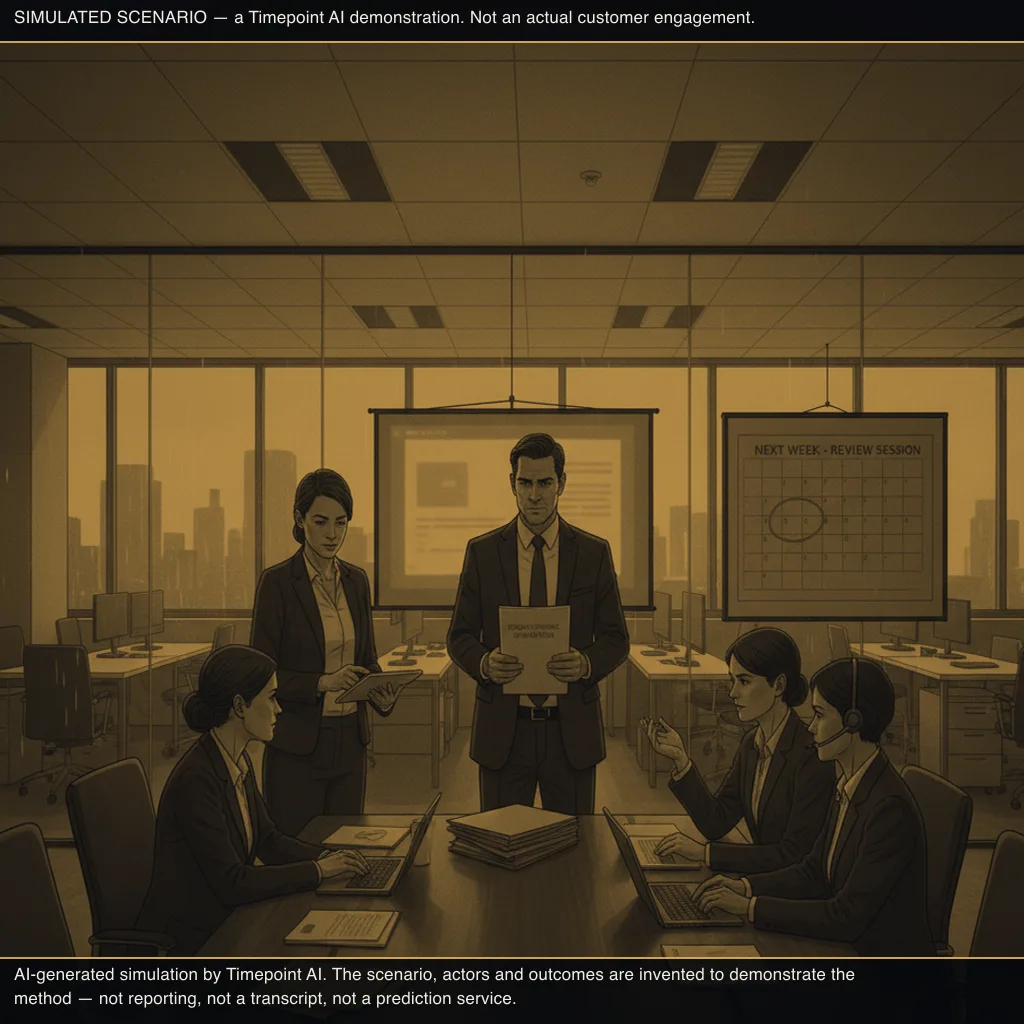
A Pro run doesn't simulate "the market." It casts actors: Marisol Vega, BeachSat's CEO — ex-oceanography, decisive, committed to the coastal plan. Theo Lindqvist, the CTO who owns the satellite ingest pipeline and thinks in buoys shipped. Surfline, the incumbent forecasting brand every advisor assumed was the enemy. Pacific Swell Co, the direct competitor nobody outside the building was watching. Each carries a persona, incentives, and a memory — and the dialog between them is generated in character, beat by beat.

FEB 2026 Founders align on Strategy A “Surf towns are where our data wins.” APR 2026 Surfline enters as channel partner The incumbent becomes distribution JUL 2026 Pacific Swell undercuts the consumer tier The stress branch arrives on schedule CAUSAL BEATS FROM THE STANDING DEMO RUN · EVERY BEAT CARRIES CAST, DIALOG, AND A CAUSAL PARENT
Three causal beats from the demo run, as the cockpit storyboard renders them. Every beat knows its cast, carries its dialog, and points at its causal parent — so you can walk the chain backward and ask "why did this happen?"

The finding: the rival wasn't who they thought

Inside the run's first beat, the founders align on coastal-first — and Marisol delivers the line that turns out to be the engagement's whole payoff: "Then we treat Pacific Swell as the real threat, not Surfline." The simulation bears her out twice over. By April, Surfline — the presumed enemy — enters as a channel partner: the incumbent needs the data more than it needs the fight. By July, Pacific Swell undercuts BeachSat on the consumer tier, right on schedule: the stress branch, arriving exactly where the run said to watch for it.

That inversion — your assumed rival is your channel; your real rival is the one undercutting you while you watch the wrong door — is what competitor-perspective analysis produces when it works. And the enterprise question resolved the same way the runs kept resolving it: the logos follow the coastal proof. Ship the buoys first.

The deliverable: a storyboard you can interrogate

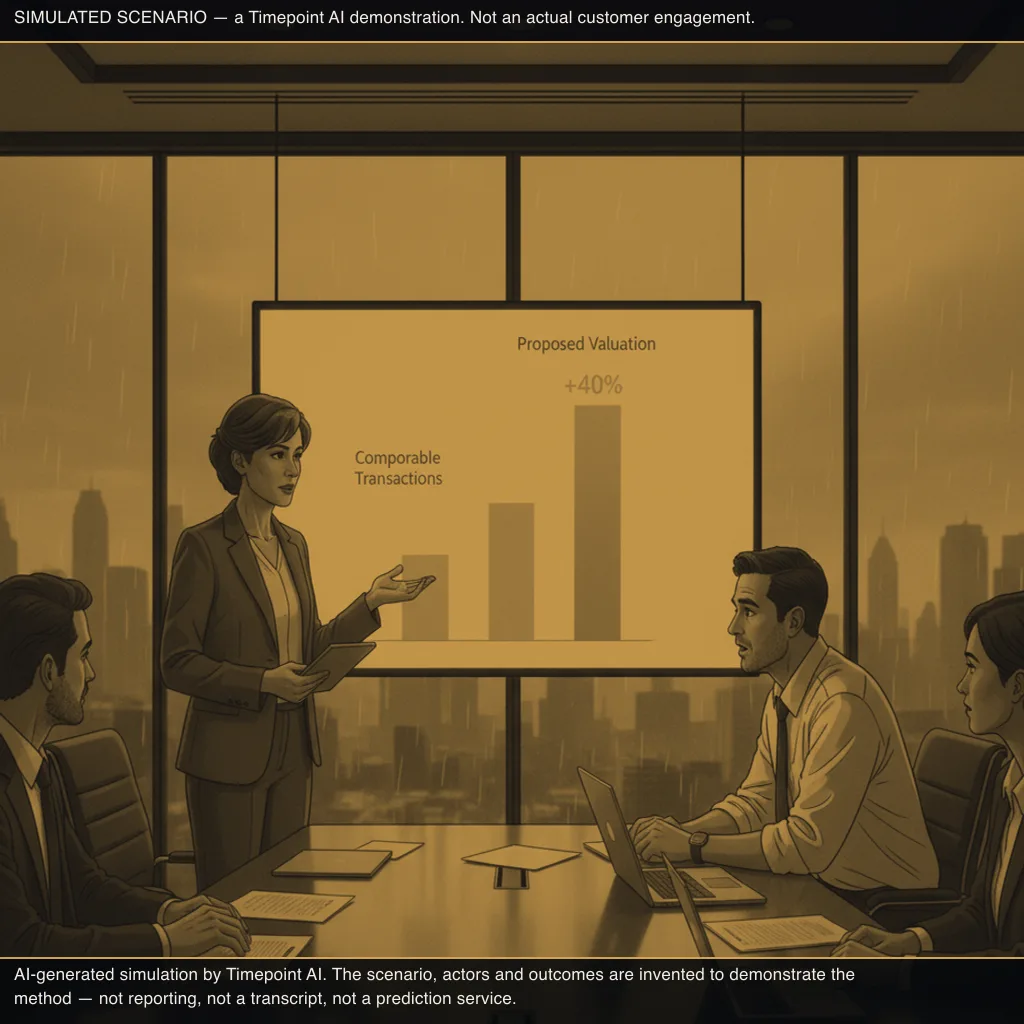
What a client receives is the thing the demo renders: a storyboard — cast, causal beats, in-character dialog, and the chain of "this happened because of that" behind every scene — plus the ranked branches with uncertainty stated in words. It's built to be argued with: challenge a beat, re-run the world, watch what changes. Where it helps, scenes render as imagery; where it matters, the reasoning is shown. Nothing arrives as a naked verdict, and an enforcement gate stands between the engine and your inbox.

See it in practice

Free field guide

Field Notes on Deal Risk — an 8-page guide to stress-testing a decision across its branches: the five practices, a worked example, and the checklist. No gate, no sales call.

Get the PDF
Read this honestly The worked example above is fictional and labeled, because we don't publish client work — and we don't publish accuracy percentages, ours or anyone's, because no published calibration record substantiates one yet (here's what we test instead). What real engagements share with the fiction is the form: ranked branches, uncertainty stated in words, disagreement between runs reported instead of averaged away, and every output labeled the AI simulation it is.
Bring us a decision What we do Pricing & engagement